
Semantic SEO is the process of optimizing website content around meaning, search intent, entities, contextual relationships, and topical relevance instead of focusing only on exact-match keywords. Modern Google algorithms use semantic understanding, Natural Language Processing (NLP), and AI-driven ranking systems to evaluate how comprehensively websites cover topics.
Search engines now analyze:
instead of relying solely on keyword repetition.
Creative Sparkx provides professional SEO Services in Lahore focused on semantic SEO, topical authority, technical SEO, and content optimization strategies designed to improve Google rankings and long-term search visibility.
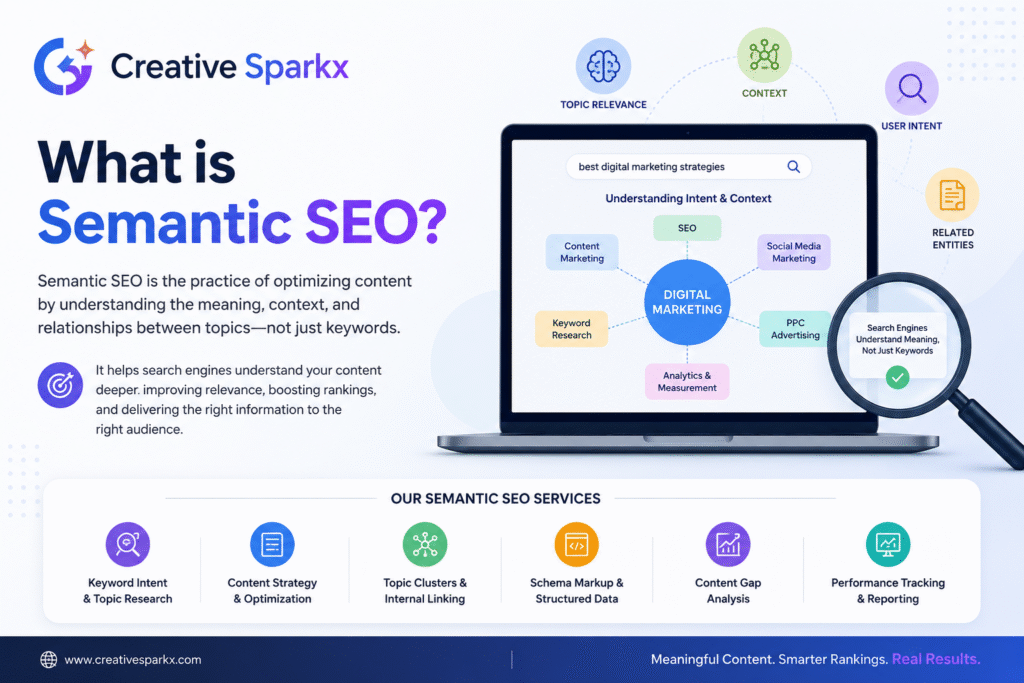
Semantic SEO helps search engines understand the relationship between topics, services, entities, and user intent. Google no longer relies only on exact keywords to rank content. Instead, search engines use contextual analysis and semantic associations to understand the overall meaning of pages.
For example, Google understands that:
are semantically related concepts.
This allows websites optimized with semantic SEO to rank for multiple keyword variations and long-tail search queries.
Modern semantic SEO strategies focus on:
instead of keyword stuffing.
Semantic SEO has become increasingly important because Google’s ranking systems continue evolving toward contextual understanding and AI-driven search experiences.
Semantic optimization helps businesses:
Websites using semantic SEO strategies often achieve stronger visibility because they provide more complete and contextually relevant information.
Google’s systems such as BERT, RankBrain, MUM, and neural matching rely heavily on semantic understanding.
Traditional SEO focused heavily on:
Modern semantic SEO focuses on:
Because of this change, websites are now required to develop substantial content ecosystems as opposed to discrete keyword-focused pages.
Creative Sparkx helps businesses transition from outdated SEO methods to modern semantic optimization strategies aligned with Google’s current ranking systems.
Semantic SEO and topical authority work together to improve search engine trust and visibility.
Topical authority refers to how comprehensively a website covers a subject. Websites publishing multiple semantically connected pages around related topics often achieve stronger rankings.
Example SEO topic cluster:
These connected pages help Google understand expertise and contextual relevance.
Learn more about topical authority strategies through our detailed topical authority guide.
Semantic keyword optimization focuses on naturally including related phrases and entities instead of repeating one keyword excessively.
Examples of semantic keywords related to SEO:
This improves:
Google prefers natural language and contextually relevant optimization.
Effective semantic SEO strategies include:
Create interconnected pages covering related topics comprehensively.
Develop content aligned with informational, commercial, and transactional intent.
Use semantic internal links connecting relevant topics naturally.
Provide comprehensive explanations instead of thin content.
Strengthen contextual relationships between brands, services, locations, and topics.
Use headings, FAQs, lists, and clear formatting for better readability.
Ensure proper indexing, crawlability, and structured data implementation.
Modern AI-driven search systems rely heavily on semantic understanding.
ni
Businesses implementing semantic SEO are better prepared for future AI-driven search experiences.
Local businesses can benefit significantly from semantic optimization.
For example, businesses targeting “SEO Services in Lahore” should also cover:
This strengthens contextual relevance and local search authority.
Creative Sparkx develops advanced semantic SEO campaigns for businesses looking to improve online visibility, Google rankings, and long-term search performance.
Semantic SEO helps businesses:
Businesses using semantic SEO often achieve stronger long-term search performance compared to websites relying on outdated optimization techniques.
Creative Sparkx provides advanced semantic SEO strategies focused on:
Our SEO experts continuously monitor Google algorithm updates and semantic search trends to help businesses maintain long-term search visibility.
Semantic SEO is the process of optimizing website content around meaning, entities, contextual relevance, and topical authority instead of focusing only on exact-match keywords.
Semantic SEO improves search relevance, topical authority, organic visibility, and AI-driven search performance.
Semantic optimization helps Google understand content meaning and contextual relationships more effectively.
Traditional SEO focused on keyword repetition, while semantic SEO focuses on contextual understanding and topic coverage.
Creative Sparkx provides professional SEO Services in Lahore using semantic SEO strategies, topical authority development, technical optimization, and content marketing methods designed to improve Google rankings, search visibility, and long-term online growth.
Contact Creative Sparkx today to improve your website with advanced semantic SEO optimization.