
On-page SEO is the foundation of strong organic visibility. Before backlinks, ads, or promotions can make an impact, your website must clearly communicate relevance, structure, and value to search engines. Proper on-page optimization ensures that every page on your website is aligned with search intent, keyword strategy, and user experience signals that influence rankings.
This guide explains the exact on-page SEO framework used to improve website relevance, increase click-through rates, and help pages rank for the right queries.
Every successful page starts with proper keyword mapping. Instead of randomly placing keywords, each page must target a specific intent.
We map:
This prevents keyword cannibalization and ensures search engines understand the purpose of each page.
Your title and meta description are responsible for clicks from search results. Even if a page ranks, poor metadata reduces traffic.
We optimize:
Search engines read structure before reading content. Proper heading hierarchy improves crawlability and topic understanding.
Best practices include:
This improves both rankings and user engagement.
Internal links tell Google which pages are most important. Without strategic internal linking, authority gets scattered.
We create internal links to:
This distributes authority and strengthens important pages.
Images contribute to rankings when properly optimized.
We ensure:
This helps in both web search and image search visibility.
Clean URLs improve crawlability and keyword clarity.
Best practices:
Thin content cannot compete in modern search results. Pages must comprehensively cover the topic.
We improve:
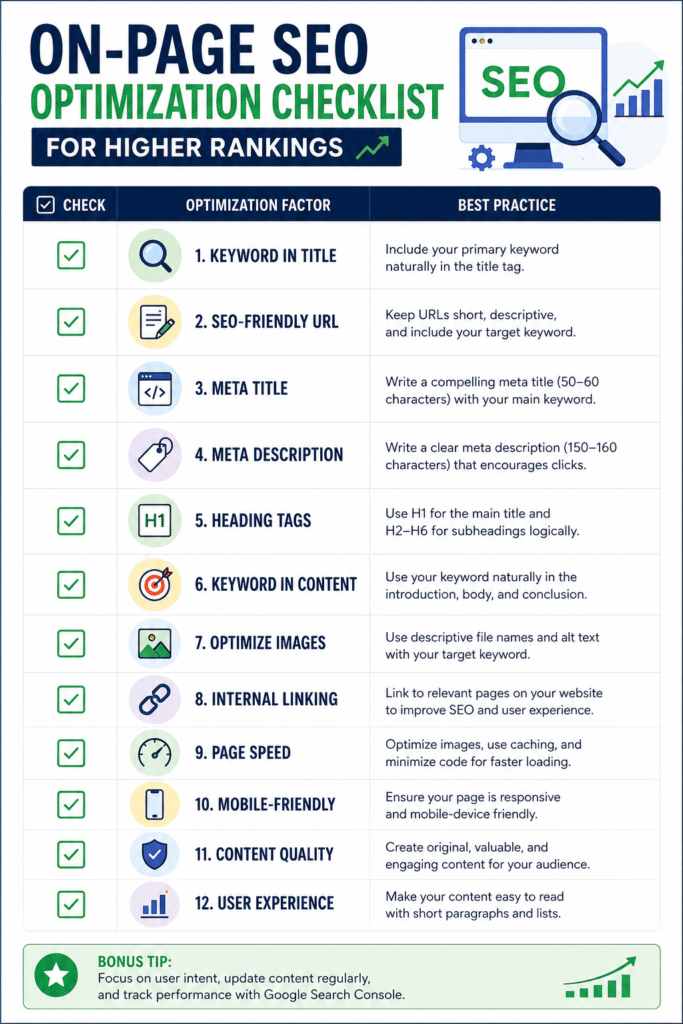
For every page, we apply this checklist:
Many websites fail to rank because of simple issues:
Fixing these often leads to quick ranking improvements.
Without on-page optimization:
On-page SEO creates the base that allows all other efforts to succeed.
If your website is not ranking despite content and backlinks, the issue is often on-page structure.
Improving on-page signals can significantly boost visibility and help search engines correctly interpret your website.